Firestop Systems Explained: A Practical Guide for Code Officials
August 17, 2026

What Is a Firestop System?
A firestop system protects openings and joints in fire-resistance-rated construction.
Pipes, cables, conduits, ducts, and other building services create openings in rated walls and floors. Joints and perimeter conditions can also interrupt the continuity of an assembly.
A listed system defines the rated assembly, penetrant type and size, opening dimensions, annular space, backing material, firestop products, required depths, compression, fastening, orientation, and other installation details. Changing one of these variables may place the installation outside the listed design.
Is Firestopping the Same as Fireproofing?
No. Fireproofing generally protects structural components, such as steel. Firestopping protects openings, joints, and transitions in fire-resistance-rated assemblies.
Using the correct terminology helps prevent confusion during design, installation, inspection, and approval.
Which Firestop Systems Should Code Officials Recognize?
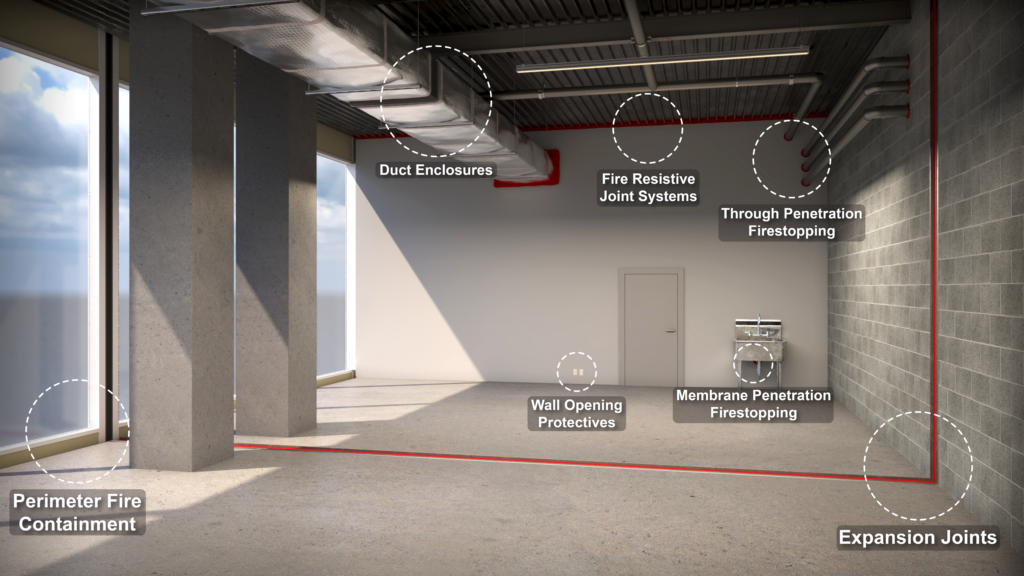
Through-penetration firestop systems protect openings where pipes, cables, conduits, ducts, or other items pass completely through a rated wall or floor.
Membrane-penetration systems address penetrations through one side of an assembly, including certain recessed boxes.
Fire-resistive joint systems protect conditions such as head-of-wall, floor-to-floor, wall-to-wall, and floor-to-wall joints.
Perimeter fire containment systems protect the intersection between a rated floor and an exterior curtain wall. Code officials may also encounter listed systems for recessed boxes, duct enclosures, cable protection, and other specialized conditions.
Why Is the Listed System More Important Than the Product?
A firestop product does not receive a fire-resistance rating by itself. It is tested as part of a specific construction system.
A product approved for one assembly, penetrant, opening, or orientation may not be acceptable for another. Product appearance or familiarity alone does not establish compliance.
Code officials should verify the rated assembly, penetrant type and size, opening dimensions, annular space, sleeve requirements, backing material, sealant depth, product identification, orientation, and any required collars, wrap strips, devices, or fasteners.
The complete installation must match the listed design.
What Should Code Officials Verify During Plan Review?
Firestop submittals should identify the listed systems proposed for the project and connect each system to the intended field condition.
Code officials should confirm consistency among the construction documents, approved submittals, specified products, listed designs, and penetration or joint details.
Generic product data is not a substitute for a listed system. Clear documentation allows designers, installers, inspectors, manufacturers, and code officials to work from the same requirements.
What Should Be Verified in the Field?
Field inspection should compare the installed condition directly with the approved system.
The inspector should verify the wall or floor assembly, penetrant material and size, opening dimensions, annular space, backing material, sealant depth, product identification, orientation, fastening, restraint, and system continuity.
An opening should not be accepted simply because it appears sealed. Measurements, product markings, approved documents, photographs, and inspection records support more consistent decisions.
What Are Common Firestop Deficiencies?
Common concerns include incorrect or unidentified products, insufficient sealant depth, missing or improper backing material, incorrect annular space, oversized openings, unlisted penetrants, missing components, incorrect orientation, unsupported substitutions, and conditions that do not match the approved system.
Each condition should be evaluated against the applicable listing rather than judged by appearance alone.
What Happens When the Field Condition Does Not Match?
When a field condition does not match a published listed system, the project team may need another listed design or an Engineering Judgment or Technical Evaluation from an appropriate qualified source.
The document should address the actual condition using relevant tested system data and sound technical reasoning. It should then be submitted through the applicable approval process.
How Does Practical Training Improve Firestop Inspection?
Hands-on manufacturer training helps code officials connect listed system requirements with real installations.
Participants can examine firestop products, backing materials, installation depths, fastening methods, system components, and common field deficiencies in a controlled setting.
This experience can improve system interpretation, field verification, documentation, communication, and coordination with project teams. Training supports professional judgment but does not replace required qualifications, approved procedures, or the authority of the code official.
Build Greater Confidence in Firestop Review
The IFC’s free training course for code officials provides practical guidance on firestop systems, listed designs, inspection priorities, and common field conditions.
Strengthen your ability to review, inspect, and document firestop installations with greater consistency.
Request Free, In-Person Training for Code Officials